


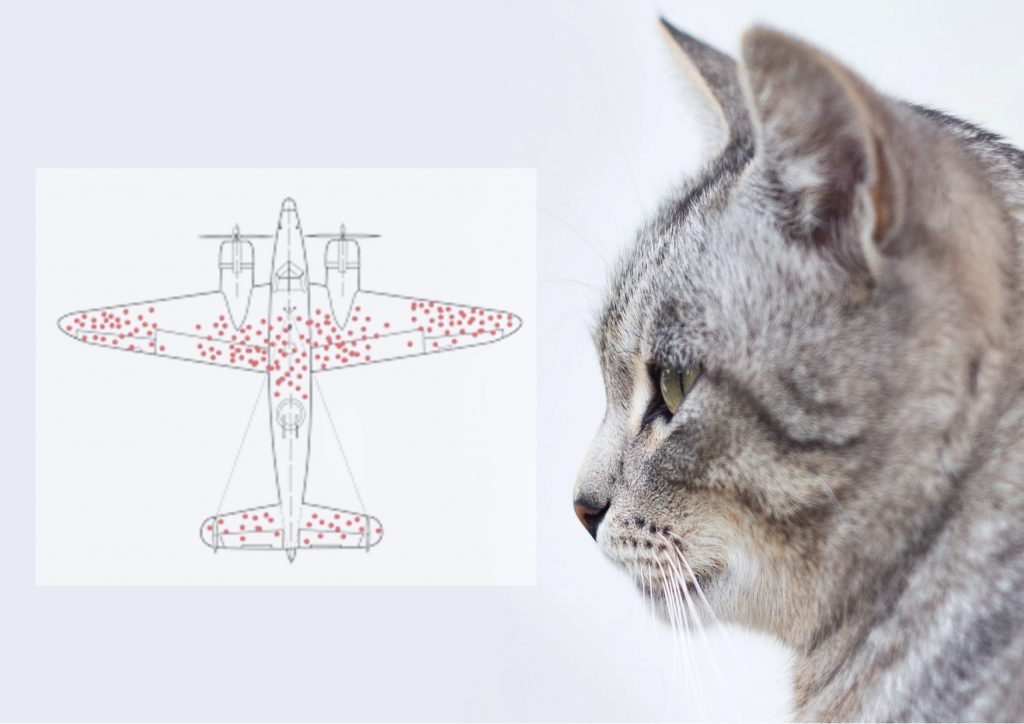
In WW2, allied air force commanders became increasingly worried about the survivability and service ratio of their aircraft. They conducted research to identify the main areas of damage on each type, to establish the most efficient use of armour plating. In the first instance, the answer was to reinforce the fuselage where the most bullet holes were. It was a theory that sounded obvious and practical.
The reality was quite different, and had it been put in practice it would have been a complete disaster. A scientist pointed out that the most vulnerable parts of the aircraft are areas without bullet damage, as these areas, when hit, cause the most damage and ultimately the loss of the aircraft and crew. The problem with the research was, it was carried out using aircraft that had safely returned from operations, and only provided the information which was available to see.
The true answer to identifying the vulnerable areas turned out to be a reverse of the obvious. The scientists realised they had disregarded parts of the returning aircraft which had not been damaged, such as the engines, cockpit, and fuel tanks. It became clear, that if an aircraft sustained direct hits to these areas, it would result in catastrophe. Providing proof that the bullet damage on returning aircraft was superficial, and armour should be fitted to the other areas as a life-saving precaution.
The scientist credited with this research was Abraham Wald and the information became known as survivorship bias, the logical error of concentrating on people or things that have made it past logical reason and the lack of visibility which can lead to incorrect conclusions. A strange study was performed in 1987 and concluded that cats that fall from less than six stories and survive, have greater injuries than cats who fall from higher levels. At face value this appears to be illogical and against scientific reason. However, looking closer into the result reveals cats more than likely reach terminal velocity at about five stories and relax, leading to less injuries. In simple terms, survivability bias distorts popular belief.
Take a moment to consider how and why you feel, and act, in the way you do? Perhaps you are not performing at work or dislike your career. The obvious thought is to find a job that is more suited to your skillset, or with a team who you feel would understand you better; that would certainly increase your positivity.
What about the diet that keeps failing and the scripted notion that you will never lose weight?
Or the musical instrument that is too hard.
Or the new car which seems out of your price range.
Or the language that you are struggling to master?
When considering our own mental health, it is easy to jump to conclusions. One of the best parts of working with a client one-to-one is the moment when they realise the answer which they are looking for becomes obsolete, and a new direction of thought is more applicable. A light bulb moment.
When clients increase their frame of reference, they begin to see and understand ideas and processes which until then, had been unattainable. From that point, answers have a much better chance of becoming positive coping strategies.
Maybe it isn’t the job which is a problem, perhaps it is the location, or the time at which your shift starts?
Or the diet is too restrictive with foods you don’t enjoy.
Would a different food source help?
Perhaps the piano is too overwhelming, a smaller instrument like the guitar might suit you better?
If you made a few financial changes, could your credit ability stretch to a new loan, allowing for the car?
Perhaps there are more resources for Spanish lessons rather than German?
If you are searching for results, looking beyond the obvious is a positive start. Ask yourself a question. What are you not considering, and what obvious answers have you disregarded?
For a discussion about how you can consider problems from a different perspective, or to book a consultation session with Louise or Duncan, click here.